
Starting a YouTube channel is hard.
The biggest problem is not editing, not equipment, and not ideas. It’s competition.
Almost every popular topic is already controlled by large channels.
If you try to rank for big keywords, your videos usually won’t appear in search at all. You simply don’t have the authority yet.
So what’s the real solution?
👉 Find keywords that people are actually searching for — but with much lower competition.
This is how small channels can:
- Get discovered faster
- Build early watch time
- Grow authority step by step
- Attract the right audience instead of random traffic
Once your channel gains strength, you can slowly expand into bigger keywords.
But at the beginning, precision always beats scale.
In simple terms:
- Early stage: prioritize low competition + high relevance
- Later stage: gradually move into higher volume keywords
Think of it like this:
You first win small battles — then you move into the main battlefield.
YouTube’s built-in search suggestion system is one of the most underrated free keyword research tools.
When you type a word into YouTube search, it doesn’t guess randomly.
Those suggestions are based on real user searches.
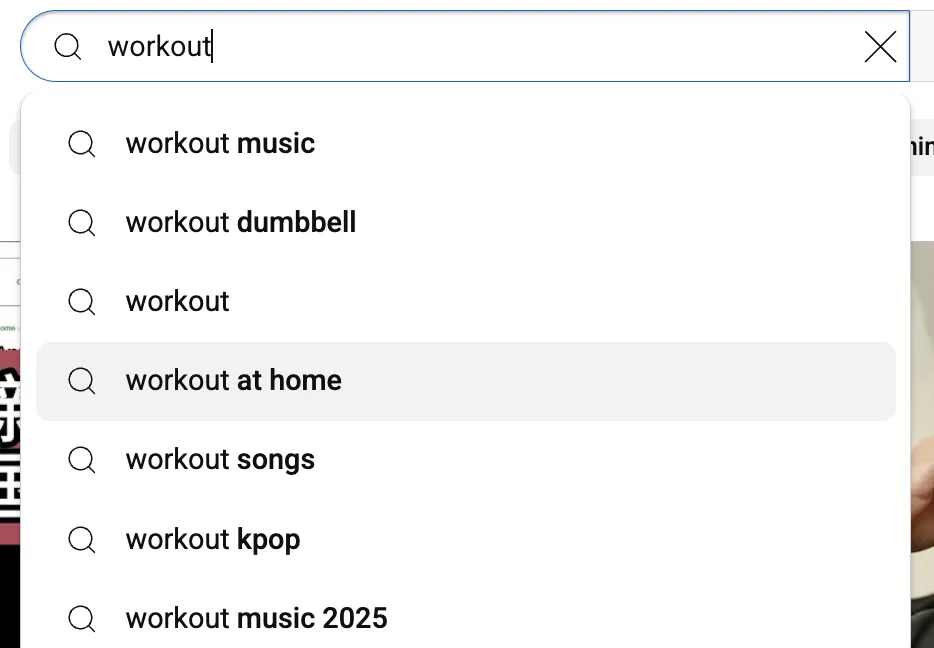
For example, when you type:
workout
YouTube may suggest:
- workout music
- workout dumbbell
- workout at home
- workout songs
- workout kpop
- workout music 2025
Now, if you make the keyword more specific:
workout at home
You may see:
- workout at home for beginners
- workout at home full body
- workout at home for belly fat
- workout at home with dumbbells
- workout at home for men
- workout at home dance
- workout at home emi wong
- workout at home 15 minutes
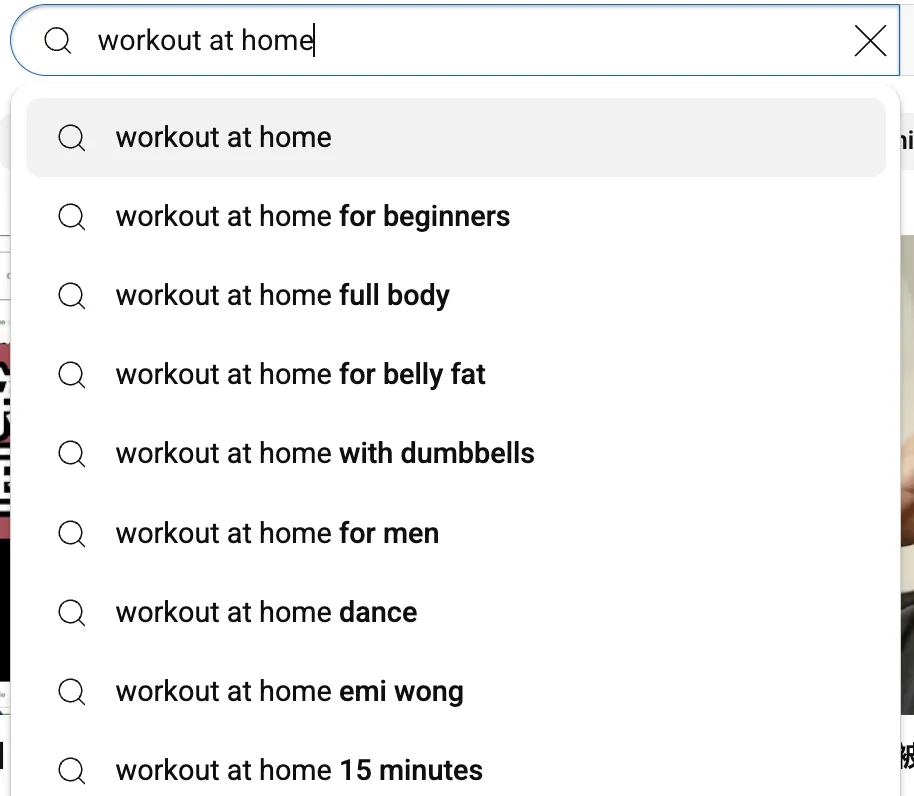
These are called long-tail keywords.
They are:
- More specific
- Much less competitive
- Still actively searched
Pro Tip
Let your title start with these exact long-tail keywords whenever possible.
That way, your video can match what users are already typing into YouTube.
Important to remember:
- The more specific the keyword is, the lower the competition usually is
- New channels should not start with the biggest keywords
- Grow from precise → medium → big keywords step by step
In short:
- Early: low competition + highly relevant
- Later: high volume + broader topics
This is the foundation that allows small channels to grow safely and consistently.
Besides YouTube’s own suggestions, you can also use professional keyword tools to judge how hard a keyword really is to rank for.
Two of the most popular tools are:
- TubeBuddy
- vidIQ
They can show you three very important numbers:
- Search Volume – how many people are searching
- Competition – how hard it is to rank
- Overall Score – a balance between volume and difficulty
Your main goal is simple:
Find keywords with high search demand but low competition,
or medium demand with medium competition (still friendly for small channels).
Example:
- “YouTube SEO” → very high search volume, very high competition
- “YouTube SEO for small channels 2025” → medium volume, low competition → perfect entry point
In YouTube SEO, there is one rule that can beat almost every other trick:
👉 The earlier you publish, the easier you rank.
This is especially true for:
- News
- Trending topics
- New product launches
- Time-sensitive reviews
When a topic has just appeared, there are almost no competitors yet.
That gives small channels a rare chance to rank on the first page.
At that moment:
- Search volume is still small
- Competition is almost zero
As the topic becomes popular:
- Search volume increases
- Your early video benefits from the growth wave

Many tech creators already use this strategy.
Before Apple officially releases a new iPhone, smart creators prepare:
- Leaked information
- Rumored features
- Early analysis videos
Once Apple releases official details, they immediately publish updated videos.
Those early videos often rank for keywords like:
- iPhone 16 launch
- iPhone 16 features explained
Because they were already indexed, they gain ranking advantage very fast.
Google Trends is not only for website SEO.
It is also extremely useful for YouTube topic prediction.
You can use it to compare keywords, for example:
- “YouTube SEO tips”
- “YouTube algorithm 2025”
This helps you see which topics are gaining attention and which are fading.
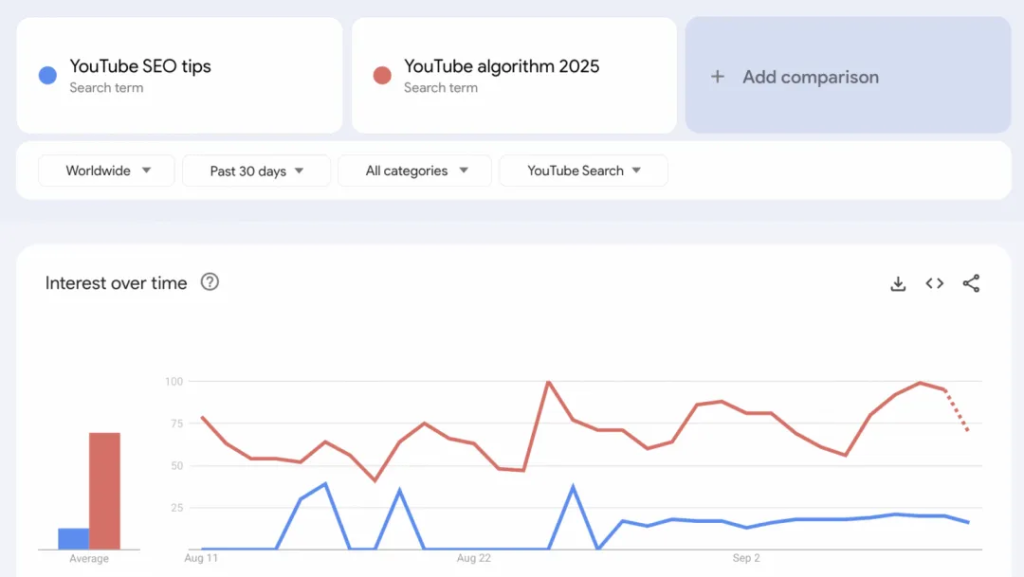
You should also check the Related Queries section:
- Rising → potential future winners
- Top → current high-demand but highly competitive topics
Strategy for small channels:
- Do not start directly with “Top” keywords
- Instead, look for Rising keywords
- These are early opportunities before competition explodes
They are like early-stage stocks — risky, but once they rise,
they can bring huge traffic to small channels.
The smaller your channel is, the more precise your niche should be.
Instead of:
- “Cooking recipes” (too broad, too competitive)
Narrow it down to:
- “Vegan recipes”
- Or even: “Quick vegan lunch recipes for college students”
The more specific your positioning is, the easier your channel can be discovered
by the exact audience that is searching for you.
After you pick a niche, the next step is to study big channels in your field.
Pay attention to:
- Which of their videos performed well?
- What questions do people keep asking in the comments?
- What useful topics are missing from their content?
These gaps are your best chances to break in.
Example
A big channel reviews the iPhone 16, but never talks about:
- iPhone 16 battery life after one week of use
You can create:
iPhone 16 battery life after one week
This solves a real search need,
and faces much lower competition.
A small Minecraft channel could not compete with big keywords like:
- Minecraft guide
So they switched to long-tail keywords such as:
- Minecraft survival tips for beginners
- Best Minecraft seeds 2025 for survival mode
These keywords are much easier to rank for.
Within two months, the channel gained over 5,000 subscribers
from search traffic alone.
If your content is time-sensitive, speed beats everything.
In YouTube SEO, there is a simple rule:
The earlier you publish, the higher your chance to rank.
This applies especially to:
- Breaking news
- Hot social topics
- New product launches
- Fresh software or game releases
When a trend just starts:
- Search volume is still low
- Competition is almost zero
That is the golden window for small channels.

As the topic becomes popular:
- Search volume grows fast
- Your early video rides the traffic wave
- You gain ranking authority before others catch up
Once large channels join later,
your early video already has a strong advantage.
In political events or celebrity controversies,
the first few hours are extremely important.
For example, when YouTube updated monetization rules in 2023,
small commentary channels that published analysis videos within 12 hours
received tens of thousands of views.
Large media channels were slower,
and missed that early ranking window.
Small channels should not try to “look big.”
They should try to solve very specific problems.
Instead of:
- “How to grow on YouTube”
Use:
- “How to get your first 100 YouTube subscribers”
- “How to get views on your first 3 YouTube videos”
These keywords may have smaller volume,
but they attract users who are ready to take action.
That leads to:
- Higher watch time
- Better engagement
- Faster channel trust building
Short videos can go viral,
but search traffic builds stable long-term growth.
For new channels, search traffic is:
- Predictable
- Repeatable
- Easier to control
Once you build a content library that ranks in search,
your channel can receive views every day, even when you are not uploading.
Let’s look at a real-world style example.
A small Minecraft channel avoided huge keywords like:
- Minecraft tips
- Minecraft guide
Instead, they focused on:
- Best Minecraft survival seeds 2025
- How to survive your first night in Minecraft
- Minecraft beginner house ideas
These keywords were much easier to rank for.
Within a short period of time,
their videos began to appear on the first page of YouTube search,
bringing stable daily views.
- Small channels should start with low-competition long-tail keywords
- Precision beats scale in the early stage
- Publish early on rising topics whenever possible
- Use search traffic as your main growth engine
- Expand into bigger keywords only after your channel gains authority
This is a safe, repeatable system that allows new channels to grow
without fighting impossible competition.