


In the crowded market of online video editing tools, it is easy to dismiss new entrants as “just another editor.” However, InVideo.io is an exception that demands attention.
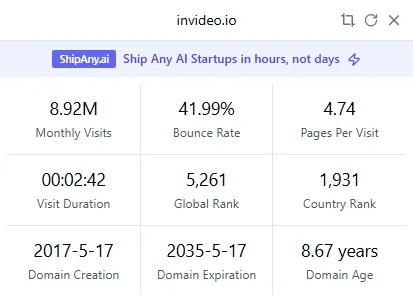
Recent data reveals that InVideo has hit a staggering $70 million in Annual Recurring Revenue (ARR). With nearly 8.9 million monthly visits, this platform isn’t just surviving; it is dominating.
How does a single tool generate over $40 million RMB (approx. $5.8M USD) per month? What separates their business model from the competition? Below, we dissect the monetization, SEO, and product strategies driving this massive growth.
1. The Numbers: Understanding the Scale
Before analyzing the how, let’s look at the what. The metrics behind InVideo paint a picture of a high-efficiency SaaS machine:
- Monthly Traffic: ~8.92 Million visits.
- Annual Recurring Revenue (ARR): ~\ $70 Million.
- Global Rank: #5,261 (trending upward).
- User Base: ~4 Million Monthly Active Users (MAU).
- Video Output: 7 Million videos generated in the last 30 days.
The Revenue Efficiency Gap To put this in perspective: If this were a standard content site relying on AdSense, 1 million views might generate a few thousand dollars. InVideo generates roughly $650,000 – $700,000 per 1 million visits. This highlights the massive leverage of the SaaS subscription model over the advertising model.
2. The Business Model: How InVideo Monetizes
InVideo operates on a classic Freemium SaaS model with a smart twist on AI consumption .
The Pricing Tier Strategy
- Free Plan: Allows users to access basic features but exports are watermarked. This serves as a “try before you buy” mechanism, offering higher conversion rates than time-limited trials.
- Plus/Business Plans ($20 – $50/mo): Removes watermarks, offers higher resolution, and provides fixed monthly AI generation minutes .
- Enterprise: White-label solutions for large clients like AT&T, P&G, and Reuters. While the customer count is lower, the contract values are high and stable.
The AI Credit System (The Profit Booster)
InVideo treats AI generation as a utility.
- Base Plan: Includes ~50 minutes of AI generation.
- Overage: Users can purchase additional minutes (approx. $0.70/minute).
Why this works:
- Low Entry Barrier: A $35/month price point is accessible for freelancers and creators.
- Scalability: Heavy users pay more, aligning pricing with value.
- High Margins: The marginal cost of AI generation is low compared to the price charged.
3. The Growth Engine: SEO & Marketing
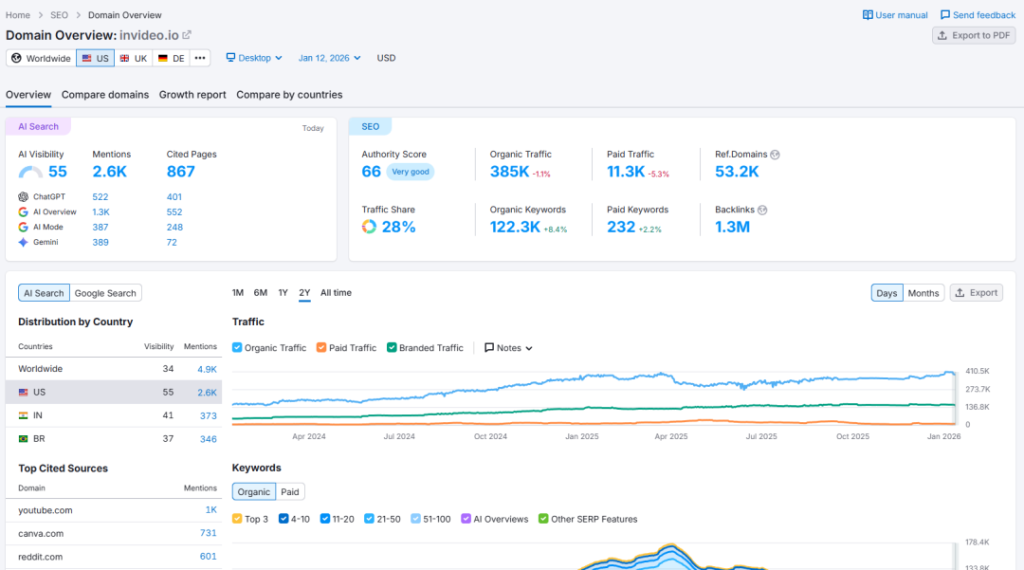
InVideo’s traffic isn’t accidental. Over 51% of their traffic comes from organic search. Their acquisition strategy relies on three pillars: Programmatic SEO, Affiliate Marketing, and YouTube.
A. Programmatic SEO (Feature-Based Landing Pages)
InVideo doesn’t just rank for their brand name. They have created specific landing pages for thousands of long-tail keywords .
- Functional Pages: “YouTube Short Maker,” “Instagram Video Editor,” “Ad Maker.”
- Template Pages: They boast over 7,000 templates. If a user searches for “Birthday video template” or “Real estate promo video,” InVideo ranks.
- Educational Content: Their blog targets high-volume queries like “Video marketing tips” and “2025 Social Media Trends”.
B. High-Ticket Affiliate Marketing
InVideo turns content creators into a sales army by offering aggressive commissions :
- 50% commission on monthly plans.
- 25% commission on annual plans.
This incentivizes influencers and bloggers to create tutorials and reviews, effectively outsourcing their sales team on a performance basis.
C. YouTube Dominance
Rather than just running ads, InVideo’s YouTube channel focuses on utility. They publish tutorials, creative tips, and success stories. A 5-minute tutorial builds more trust and product understanding than a generic landing page ever could.
4. Product Strategy: Why Users Stay
The video editing market is a “Red Ocean” (highly competitive), with rivals like Canva, Veed.io, and CapCut. InVideo differentiates itself through Accessibility and Assets .
- “Text-to-Video” Simplicity: The core value proposition is speed. Users can input a script, and the AI generates a video. This appeals to the non-technical market.
- Massive Asset Library: Through a partnership with iStock, users get access to premium footage without leaving the editor. This solves the pain point of hunting for stock media.
- Multi-Language Support: Unlike many US-centric tools, InVideo supports video creation in 75+ languages, allowing them to capture a global user base ignored by competitors.
5. Strategic Takeaways
InVideo’s success offers a blueprint for modern SaaS growth:
- Solve the “Blank Page” Problem: By offering 7,000+ templates and AI generation, they remove the hardest part of creation—starting.
- SaaS > Ads: Building a tool with recurring revenue is infinitely more valuable than building a content site for ad revenue.
- SEO is a Long Game: InVideo has been building authority since 2017. Their dominance is a result of consistent content investment, not a viral fluke.
- Empower Your Promoters: A 50% affiliate commission might seem high, but it guarantees zero Customer Acquisition Cost (CAC) risk—you only pay when you earn.
Final Thoughts
InVideo proves that you don’t need to invent a new industry to succeed. You simply need to lower the barrier to entry for users and build a robust organic traffic engine. While generating $70M might be out of reach for most indie developers, the principles used here—SEO, freemium funnels, and affiliate leverage—are applicable to any digital product.