


Key Takeaways
- BuzzFeed generates $15.4M per month, with affiliate commerce accounting for over 50% of total revenue.
- Programmatic ads are used mainly as inventory fill, not the primary income source.
- Long-tail SEO combined with viral entertainment content drives exceptionally high RPM ($64–$103).
- Shopping content is seamlessly embedded into entertainment, turning content itself into the conversion engine.

Introduction
While researching AI-driven content websites, the author initially focused on automated content production models. Recently, attention shifted to a much more mature player — BuzzFeed.
At first glance, BuzzFeed appears to be an entertainment site built on quizzes and gossip-driven lists. But a deeper analysis reveals a far more sophisticated operation. Its monetization system and operational strategy are significantly more complex than they seem on the surface.
With an estimated monthly revenue of $15.4 million (Q3 2025), BuzzFeed offers a powerful case study on the true commercial potential of content websites.
This article breaks down how BuzzFeed monetizes traffic at scale — and what other content site owners can learn from it.
Key Numbers at a Glance
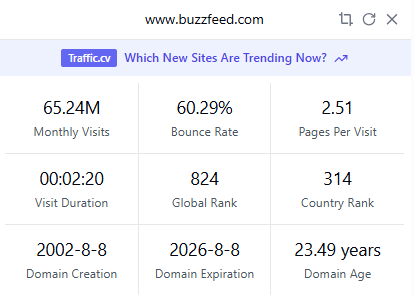
- Website: buzzfeed.com
- Average Monthly Revenue: $15.4M (Q3 2025)
- Monthly Visits: 65.24M
- Global Rank: #824
- Core Audience: Gen Z and Millennials
One of the most surprising insights is that each visitor generates approximately $0.25 in revenue.
For context, many content sites struggle to reach even $0.05 per visitor. The reason BuzzFeed outperforms lies in its dual-engine model: programmatic advertising + affiliate commerce.
Business Model: More Than Just Advertising
Revenue Breakdown (Q3 2025)
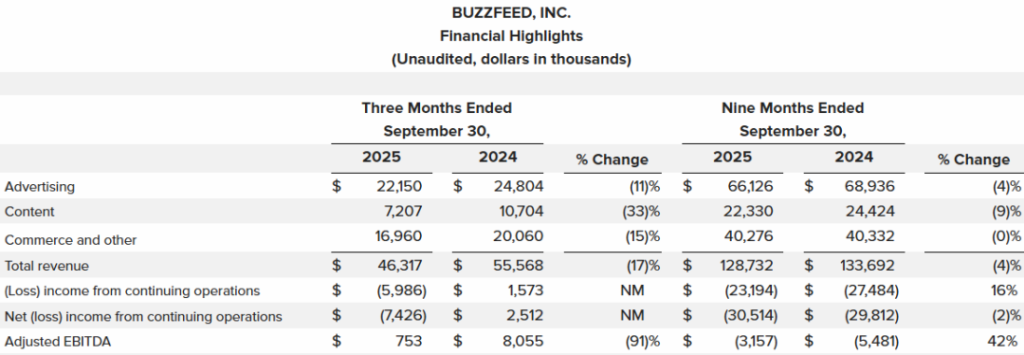
BuzzFeed’s average monthly revenue of $15.4M can be roughly broken down as follows:
- Programmatic Advertising: ~$7.4M (48%)
- Affiliate Commerce & Other Revenue: ~$8.0M (52%)
This distribution challenges the traditional belief that content sites must rely primarily on ads. BuzzFeed has successfully turned commerce into its largest revenue driver.
Notably, ad revenue declined 11% year-over-year in Q3 2025, while affiliate commerce continued to grow. This clearly indicates a strategic shift away from pure ad dependence.
How BuzzFeed Uses Google AdSense
Many assume Google AdSense is a tool for small websites, while large publishers rely exclusively on direct ad sales. BuzzFeed takes a more strategic approach.
AdSense is used primarily as an inventory fill solution, not as a core revenue channel.
An analysis of BuzzFeed’s ads.txt file shows multiple authorized Google publisher IDs, allowing the use of display, responsive, and native ads.
This strategy delivers three key advantages:
- High-value placements are reserved for direct sales and sponsored content
- Long-tail pages and low-traffic sections are monetized via AdSense
- Every ad slot generates revenue, minimizing wasted inventory

SEO Strategy: Where the Traffic Comes From
Long-Tail Keyword Focus
BuzzFeed’s SEO strategy closely mirrors that of other large publishers, with a strong emphasis on long-tail keywords. The difference lies in how entertainment is woven into search intent.
Typical examples include:
- “Which Taylor Swift Era Matches Your Love Life?”
- “Photos That Aged Incredibly Poorly”
- “Things for a Clean Organized Home”
These keywords share three characteristics:
- Lower search volume but higher conversion intent
- Relatively low competition
- Strong alignment with social sharing behavior
An analysis of BuzzFeed’s homepage content shows that nearly every article targets a specific long-tail keyword. This precise keyword strategy explains why approximately 45.89% of its traffic comes from organic search.
Content Strategy: The Mechanics of Virality
The Four Content Pillars
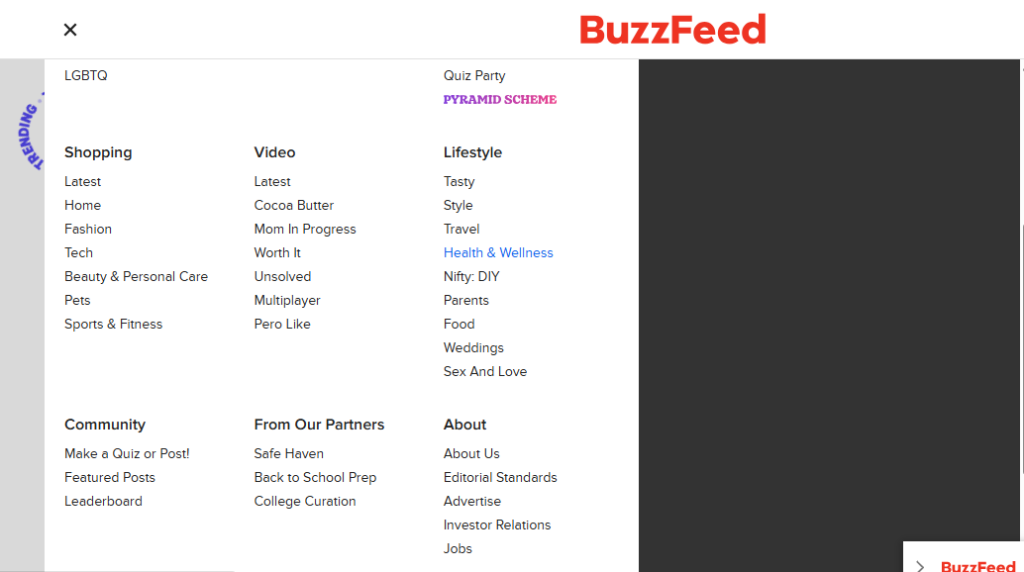
BuzzFeed’s content can be categorized into four main types:
- Viral Lists
Example: “48 Photos That Aged So Incredibly Poorly” - Interactive Quizzes
Example: “Which Taylor Swift Era Matches Your Love Life?” - Shopping Recommendations
Example: “53 Things for a Clean Organized Home” - Emotional & Relatable Stories
User-submitted relationship stories and personal anecdotes
Each content type serves a distinct purpose:
- Lists and quizzes drive traffic
- Shopping content drives direct monetization
- Emotional stories increase user retention
The Power of High-Frequency Publishing
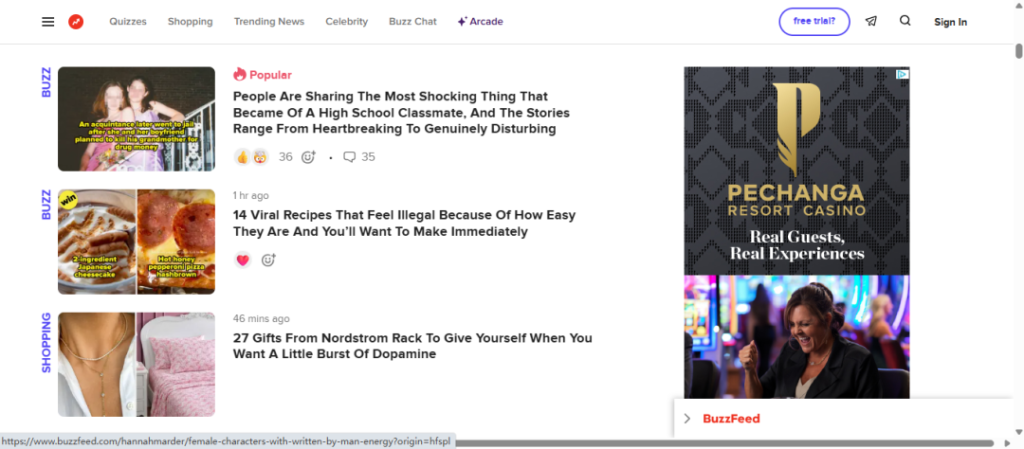
BuzzFeed updates content at an extremely high frequency. New articles appear on the homepage almost every hour.
This approach delivers several benefits:
- Search engines crawl the site more frequently
- Users return more often due to fresh content
- Social platforms always have new material to distribute
While BuzzFeed does not rely entirely on automation, its content production process is clearly highly standardized, enabling sustained output at scale.
How Shopping Content Converts So Well
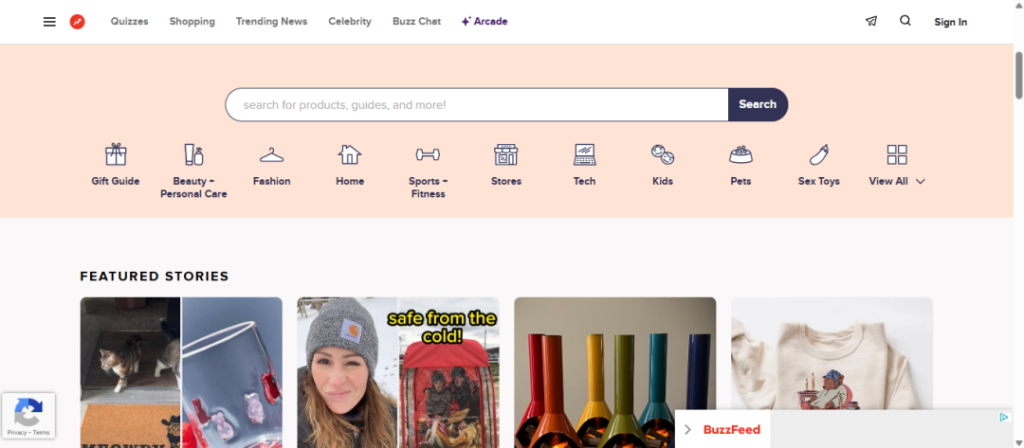
BuzzFeed’s commerce strategy stands out because products are not presented as traditional ads. Instead, shopping recommendations are embedded directly into entertaining content.
For example, an article titled “53 Things for a Clean Organized Home” appears to be a lifestyle guide, but each recommended product contains an Amazon affiliate link.
This “content-as-conversion” model significantly outperforms traditional banner ads. Users are actively seeking solutions, rather than passively consuming advertisements.
Based on estimated figures:
- Affiliate revenue: ~$8.0M per month
- Monthly visits: ~60M
- Affiliate value per visitor: ~$0.13
This is an exceptionally high figure for a content-based website.
User Experience: Designed for Endless Consumption
The Infinite Scroll Effect
BuzzFeed’s homepage uses an infinite-scroll layout, which encourages continuous consumption.
Once an article is finished, the next one loads automatically. Combined with algorithmic recommendations, users easily fall into a “just one more” loop.
The average session duration reaches 9 minutes and 37 seconds, a strong metric for entertainment media sites.
Social Interaction Features
Each article includes emoji reactions and a comment section.
This design serves multiple functions:
- Increases user engagement
- Collects real-time feedback
- Provides social proof — articles with more reactions attract more clicks
Data shows that pages with interactive elements can increase average time-on-site by over 30%.
Monetization Performance Analysis
Exceptionally High RPM
Based on available data:
- Monthly revenue: $15.4M
- Estimated monthly pageviews: 150M–240M
- RPM: ~$64–$103
For comparison, most content sites achieve RPMs between $10–$30. BuzzFeed’s performance sits firmly in the top tier.
Key reasons include:
- High-converting commerce content
- Precision-targeted programmatic ads
- Subscription offerings (BuzzFeed+)
Diversified Revenue Streams
BuzzFeed avoids relying on a single monetization channel. Its revenue mix includes:
- Programmatic Advertising: ~$7.4M (48%)
- Affiliate Commerce: ~$8.0M (52%)
- Subscriptions: ~$1–2M (5–10%)
This diversified structure helps stabilize revenue during market fluctuations. When ad revenue declines, commerce compensates. During economic slowdowns, subscriptions provide consistent cash flow.
Challenges and Risks
BuzzFeed is not without challenges:
Declining Ad Revenue
A 11% YoY decline in ad revenue is a warning sign. With the rise of AI-driven search and zero-click results, traditional display ads may continue to face pressure.
BuzzFeed’s response — increasing its focus on affiliate commerce — is strategically sound, but commerce revenue is also sensitive to consumer spending cycles.
Platform Dependency
Despite efforts to reduce reliance on social platforms, they remain a significant traffic source. Algorithm changes on platforms like Facebook can still cause sharp traffic volatility.
Reduced Content Depth
After shutting down BuzzFeed News, the site shifted entirely toward entertainment and commerce. While this improves short-term profitability, it may weaken long-term brand authority.
Key Lessons for Content Site Owners
Content + Commerce Works
BuzzFeed demonstrates that integrating commerce into content can generate significantly higher revenue than ads alone — when done naturally.
Diversification Is Critical
Relying on a single monetization method is risky. A diversified revenue structure provides resilience against market shifts.
A typical approach might look like:
- Primary Revenue: Affiliate commerce
- Secondary Revenue: AdSense inventory fill
- Long-Term Revenue: Subscription products
Final Thoughts
BuzzFeed challenges the idea that content websites are obsolete in the AI era. Its success shows that with the right strategy, content sites can still generate tens of millions of dollars per month.
The key principles are clear:
- Diversify monetization
- Prioritize mobile-first experiences
- Maintain high publishing frequency
- Seamlessly integrate commerce
- Use technology to improve efficiency
BuzzFeed has its flaws, but its monetization framework remains one of the most instructive examples in the modern content economy.
Ultimately, building a successful content site is not about producing the deepest content — it’s about understanding user intent and converting attention into sustainable revenue.